|
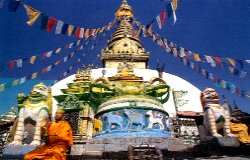 The history of the Valley, according to the legends, begins with Swayambhu,
or "the self-existent". In times uncharted by history, Bodhisattva Manjusri
came across a beautiful lake during his travel. He saw a lotus that emitted brilliant
light at the lake's center, so he cut a gorge in a southern hill and drained the waters
to worship the lotus. Men settled on the bed of the lake and called it the Kathmandu Valley.
From then on, the hilltop of the Self-existent Lord has been a holy place. Swayambhu's light
was covered in time because few could bear its intensity. By the thirteenth century, after many layers were added to the
original structure that enveloped the Lord's power, a dome-like shape had been acquried. The stupas central mast was
damaged and replaced at that time. Peripheral sources of power were
discovered on the hilltop as well and stupas, temples, and resthouses were built to honor them.
Image of important deities, both Buddhist and Hindu, were also installed. Today, age-old statues and shrines dot the
stupa complex. Behind the hilltop is a temple dedicated to Manjusri of
Saraswati - the goddess of learning. Swayambhu is the best place to observe the religious harmoney in Nepal.
The stupa is among the most ancient in this part of the world, and its
worshippers are diverse from Newar nuns, Tibetan monks, and Brahmin priests to lay Buddhists and Hindus.
The largest image of the Sakyamuni Buddha in Nepal is in a monastery next to the stupa. Other monasteries here have
huge prayer wheels, fine Buddhist paintings. Swayambhu is a major landmark of the Valley and looks like a beacon
below the Nagarjun hill. It provides an excellent view of the Kathmandu Valley. The history of the Valley, according to the legends, begins with Swayambhu,
or "the self-existent". In times uncharted by history, Bodhisattva Manjusri
came across a beautiful lake during his travel. He saw a lotus that emitted brilliant
light at the lake's center, so he cut a gorge in a southern hill and drained the waters
to worship the lotus. Men settled on the bed of the lake and called it the Kathmandu Valley.
From then on, the hilltop of the Self-existent Lord has been a holy place. Swayambhu's light
was covered in time because few could bear its intensity. By the thirteenth century, after many layers were added to the
original structure that enveloped the Lord's power, a dome-like shape had been acquried. The stupas central mast was
damaged and replaced at that time. Peripheral sources of power were
discovered on the hilltop as well and stupas, temples, and resthouses were built to honor them.
Image of important deities, both Buddhist and Hindu, were also installed. Today, age-old statues and shrines dot the
stupa complex. Behind the hilltop is a temple dedicated to Manjusri of
Saraswati - the goddess of learning. Swayambhu is the best place to observe the religious harmoney in Nepal.
The stupa is among the most ancient in this part of the world, and its
worshippers are diverse from Newar nuns, Tibetan monks, and Brahmin priests to lay Buddhists and Hindus.
The largest image of the Sakyamuni Buddha in Nepal is in a monastery next to the stupa. Other monasteries here have
huge prayer wheels, fine Buddhist paintings. Swayambhu is a major landmark of the Valley and looks like a beacon
below the Nagarjun hill. It provides an excellent view of the Kathmandu Valley. |
